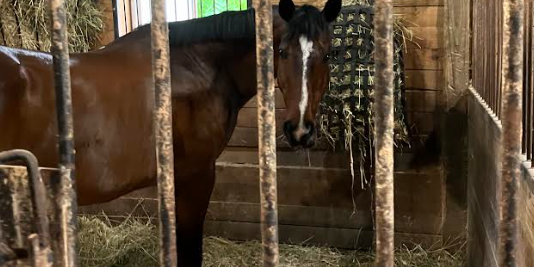
William the Horse
William is a 15 yr.old thoroughbred horse who lived in rural Massachusetts and the backwoods of Maine for most of his life. His owner recently moved from Bath, Maine to Indiana, about 20 minutes outside of Indianapolis, and she found a barn for William near her home.
When he was in New England, William was known for loving to be outside, running around in his paddock. He didn’t particularly like being inside, in the barn (he was always housed in a barn, as his owner didn’t have the space for him to have him at her home). His owner, Karen, visited him almost every day and is finely tuned into his likes and dislikes and his personality.
However, the move to Indianapolis threw everything up in the air. While Karen believed that she had found a great barn for William, his behavior was strange and new. He was acting the exact opposite of how he’d been in Maine. He was fine inside the barn, for example, in his stall, but he either refused to be outside in the paddock or had erratic behavior and appeared erratic and upset outside.
Not knowing what else to do, Karen asked me to contact William and to ask him why he suddenly didn’t want to be outside but seemed okay inside his stall. I asked her to send me images of William and she included a photograph of him in his outside paddock, which was helpful when I connected with him.
I asked William, first, why he didn’t want to go outside anymore. He shared with me that there was a smell he didn’t understand, coming from the trees (as I could see in the photo). He said he was afraid because of the scent.
Next, I asked him why he was calm inside his stall, as opposed to outside. He responded that he understands the inside smells – they are all familiar to him. He shared with me the scents of hay, the water, the warmth, and the general aroma of horse stalls. “I know these smells,” he said.
I asked what I could do to help him with his anxiety and he said that he doesn’t feel safe. I asked if he was in pain or distress, and he said he wasn’t in pain but he was afraid. He then shared the scents that made him nervous more specifically, as strange animals, and I distinctly remember the pungent smell he shared as “bobcat.”
As a human, I thought that this must be incorrect – as there shouldn’t be bobcat in an area that close to Indianapolis. I shared this with Karen and suggested that maybe neighbors to the barn were spraying their vegetation with some kind of bobcat or lynx urine-type spray to keep away deer. She didn’t think that was the case but confirmed that William definitely didn’t want to be near the trees when he was outside.
Having just moved to the area, Karen needed to find a new veterinarian. One week after I did the session with William, the new vet came out to the barn to look at him. Karen shared with her William’s new behavioral issues, and also shared that she’d asked me (an animal communicator) to connect with William. The vet assured Karen that she’d worked with animal communicators before and was open to hearing what they learn.
Karen told her that Williams was afraid of being outside because “he smelled a predator, and was afraid.”
“Oh, yes. That makes sense,” the vet responded, “he smells bobcat. He’s probably never smelled them before, being from the Northeast. We have bobcat here.”
Karen called me as soon as the veterinarian had left, to share the confirmation of the bobcat! And now, to compensate for William’s fear, she’ll be constructing a smaller paddock, away from the trees, so he can feel safer outside the barn.